


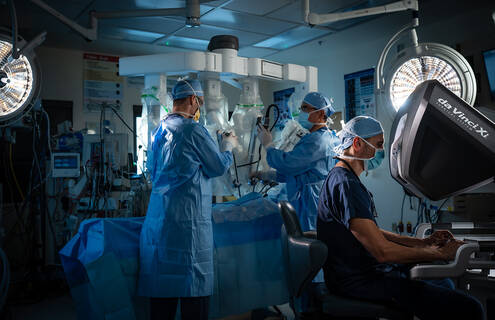
Minimally invasive and robotic-assisted cardiac surgery procedures are in increased demand.
Our cardiac surgeons say these procedures now account for approximately 15 to 18% of their cardiac surgical cases.
That is significant growth, says Jose R. Rodriguez, MD, director of Dartmouth Health’s Minimally Invasive Cardiac Surgery and Quality program.
“Some of these procedures aren’t available in larger cities and are only offered at select centers across the U.S.,” he says.
Here’s more on the program and procedures that are growing in recognition and demand.
What does minimally invasive mean?
Minimally invasive cardiac surgery (sometimes called MICS) is a new way to perform heart bypass procedures for treating coronary heart disease.
To do it, the surgeon uses specialized surgical instruments to access the heart through a small incision on the left side of the chest.
This method is less invasive than traditional open-heart surgery because it involves making small incisions between the ribs, avoiding splitting the breastbone or sternum open. The result is reduced trauma and quicker patient recovery.
What is robotic-assisted cardiac surgery?
Robotic cardiac surgery is a highly specialized form of minimally invasive surgery.
For this form of surgery, the surgeon uses a computer-controlled robotic system, which brings enhanced precision.
Procedures that fall under this type of surgery include:
- Robotic mitral valve repair (MVR)
- Robotic aortic valve replacement (AVR)
- Totally endoscopic coronary artery bypass (TECAB)
“We’ve been offering robotic mitral valve repair since August 2025 and TECAB since September 2025. We added robotic AVR in March 2026,” says Rodriguez, noting that Dartmouth Health was the first in New England to offer all three procedures.
The program is getting attention from other leaders in the field
The team has begun sharing its experience with the broader cardiac surgery community, both through on-site visits and conference presentations.
In December 2025, team members presented a video poster demonstrating minimally invasive redo mitral valve surgery at the Mitral Conclave in New York City.
Increased interest in the program comes as the cardiac surgery team continues to refine established robotic techniques.
The recent introduction of an EndoBalloon platform for robotic mitral surgery provides another option for a less invasive approach. This platform means reduced external manipulation of the ascending aorta, decreasing complication rates, says Rodriguez.
Learning and growing through research
For Rodriguez, another exciting part of building a minimally invasive cardiac surgery program has been the research.
Among research initiatives is the study of the success and reproducibility of a unique approach to robotic mitral valve repair known as the “Dartmouth Repair.”
Research on the Dartmouth Repair focuses on standardizing steps and simplifying the technique to enable more effective teaching to surgeons with varying levels of experience. Ultimately, the goal is to make the procedure more reproducible and potentially applicable across a broad range of cardiac surgery practices.
Another study is exploring developing a comprehensive postoperative care pathway after a specific type of surgical ablation for atrial fibrillation. That pathway includes medical management, rhythm surveillance, and longitudinal follow-up.
Future growth
As the minimally invasive cardiac surgery program grows, patient safety remains the priority, says Rodriguez.
“We first decide what operation the patient needs and then ask whether it can be performed safely through a minimally invasive approach, not the other way around. We can offer the best operation with the least necessary trauma and provide the best long-term results.”
And although Dartmouth Health is already a regional referral center for advanced cardiac care, the team’s long-term vision is even bigger.
“The field of robotic and minimally invasive cardiac surgery is rapidly expanding, and although we are less than one year into this program, I envision Dartmouth Health becoming a destination center for minimally invasive cardiac surgery,” says Rodriguez.
“We have the tools and the opportunity to grow this program while maintaining our focus on patient selection, outcomes, innovation, and education,” he says.