



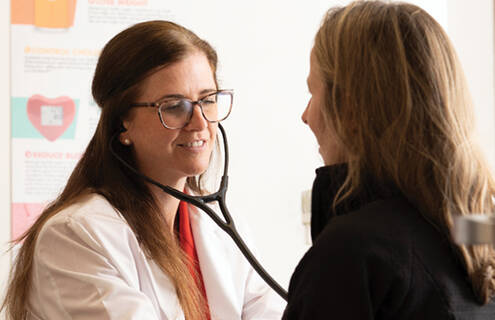
When you identify a person with FH, you identify their whole family.
Cardiologist Kerrilynn Hennessey, MDSuffering a heart attack in your 30s may seem like bad luck. But for some families, like Terry Sturke’s, a heart attack is commonplace.
On Sturke’s father’s side, many family members have died in their 30s. In cases like these, the cause is not misfortune or unhealthy habits. It is genetics.
Familial hypercholesterolemia (FH) is an inherited disorder that affects some 34 million people worldwide. The disorder is caused by a mutation in a gene that controls how cholesterol is cleared from the body.
Although the disorder can be managed with cholesterol-reducing medications, 90% of people with FH are oblivious to their condition. If left untreated, FH causes bad cholesterol levels to skyrocket, starting from birth, increasing the risk for heart disease up to 20 times.
“If it’s diagnosed and treated particularly early in life, you see that patients have the same life expectancy as any other person, as long as we control their cholesterol,” says Dartmouth Health Cardiologist Kerrilynn Hennessey, MD, who is also an assistant professor at the Geisel School of Medicine at Dartmouth. “But if we don’t, then people can start having heart attacks in their 30s and 40s.”
To increase diagnoses and awareness, Hennessey, along with then fellow Cardiologist Mary McGowan, MD, launched the TREAT-FH pilot project at Dartmouth Health.
How the pilot project got off the ground
While FH can manifest in anyone with the mutated gene, it is significantly more common in New England, as individuals of French-Canadian ancestry are more likely to have inherited FH.
To find eligible patients, Hennessey and McGowan, along with a diverse group of collaborators, developed an innovative protocol that leveraged a machine learning model developed by the Family Heart Foundation to go through anonymized records.
The algorithm looked for evidence of FH, a prohibitively time-consuming task for a human. When an FH pattern was identified, the team deanonymized the patient’s record and scrutinized their full medical history.
Ultimately, this protocol identified 61 previously undiagnosed people who were likely to have FH, as well as 16 additional patients with other types of high-risk indicators. The team reached out to each patient to confirm the diagnosis and begin treatment.
“I had some patients say to me, ‘I finally understand my family’s curse where everyone was dying young of heart disease,’” says McGowan, who has since retired from Dartmouth Health.
How the program has grown
The TREAT-FH program ran from 2021 to 2024 at Dartmouth Health and has also been implemented at five other medical institutions.
Hennessey and her team are now exploring sustainable ways to continue improving FH awareness among Dartmouth Health’s patient population.
Since parents with FH have a 50% chance of passing FH on to their children, programs like TREAT-FH can also create cascades of diagnoses beyond the patients initially identified.
“When you identify a person with FH, you identify their whole family,” Hennessey says, noting that on average, eight other family members are identified following the first diagnosis.
Why early identification matters
Early identification is essential for helping people manage their FH.
Sturke, who is an advocate with the Family Heart Foundation and served as a patient advisor to the TREAT-FH team, was first diagnosed at a young age after her sister, a teenager at the time, was diagnosed following the development of cardiac chest pain.
Over the years, Sturke’s sister has taken medications, received therapy, and undergone bypass surgery to treat her FH.
“My sister, who never thought that she would see 40, recently turned 80,” Sturke says. “And she’s still going strong.”
Now, with innovative tools like TREAT-FH, more families like the Sturkes can be identified and treated.
This article first appeared in Vitals Magazine, a publication of Dartmouth Health and Geisel School of Medicine, and has been edited for the Dartmouth Hitchcock Medical Center and Clinics website.