



We are one of fewer than 20 centers in the country with an IDE to modify endografts in-house.
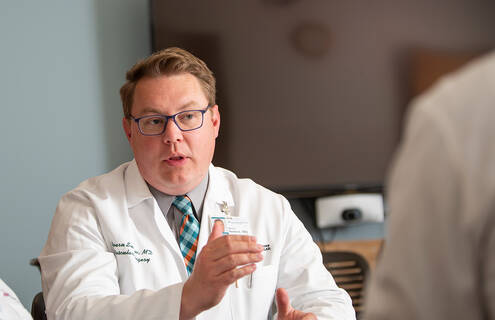
Bjoern D. Suckow, MD, MSFor Dartmouth Health Vascular Surgeon Bjoern D. Suckow, MD, MS, and his team, minimally invasive, complex aortic aneurysm repair is a sought-after alternative to open-heart surgery.
To do this type of repair, they use a range of specialized medical tools inserted through blood vessels via a catheter and customized to each patient’s unique anatomy.
Their ability to simultaneously adapt to a patient’s needs and be minimally invasive is making Suckow and his team one of the leading providers of endovascular techniques for complex aortic aneurysm repair in New England.
Customized endograft options for you
While the procedure itself is not new, what is new is the ability to customize the endograft, a tube used in endovascular repair.
Since the 1990s, the use of 'off-the-shelf' endografts with preconfigured designs has increased, with several devices now available to treat different sections of the aorta.
But the off-the-shelf solution isn’t always ideal, and so, Suckow and his team have been working closely with companies that create customized endografts based on interactive 3D models to fit each patient’s specific anatomy.
Now, having been granted an investigational device exemption (IDE) by the U.S. Food and Drug Administration (FDA), he and his team can create these customized endografts in-house at their lab at Dartmouth Hitchcock Medical Center and offer potentially life-saving emergency care to patients across northern New England.
“We are one of fewer than 20 centers in the country with an IDE to modify endografts in-house,” he says.
The expanse of their work is growing
Suckow and his team are currently participating in 12 clinical trials of new devices, medications, and interventions to slow aneurysm growth.
“We can enroll any patient with an aneurysm in one of our clinical trials,” says Suckow. “We are consistently among the top enrollers for our national clinical trials and are involved in educating other vascular surgeons on the use of innovative devices.”
The team is also involved in research on the psychological aspects of aortic aneurysm care—including how well patients understand their condition, the degree of anxiety or fearfulness patients experience as a result of their aneurysm, and how it affects quality of life.
State-of-the-art technology
Colleagues from across the nation and world are now visiting the lab’s demonstration site to learn more.
But what’s behind their success extends well beyond the devices themselves.
“We have two state-of-the-art hybrid operating suites equipped with intraoperative imaging that allows us to map the surgery and project real-time images onto previous x-rays,” says Suckow. “As a result, we can see better and safely do more with less radiation.”
Once more, in addition to being able to work with what Suckow calls “a fully functional team that runs like a well-oiled machine,” Suckow works closely with referring vascular surgeons across the region to care for patients with complex aortic aneurysms.
He also assists primary care providers with assessing and managing aneurysms over the long term.
Success still comes down to treating each patient
Suckow and his team continue to work to ensure the procedure remains minimally invasive, allowing patients to get back to living with as little disruption as possible.
“If a patient needs a higher level of care or ongoing monitoring, they can have their imaging and bloodwork done in their immediate community,” says Suckow. “And if they need surgical care, they only have to travel to us once for their procedure, where they have access to the same options available at any other academic medical center in the country. Most patients stay one night after surgery and can receive all their follow-up care locally,” he says.
Related Articles
Learn more about: