



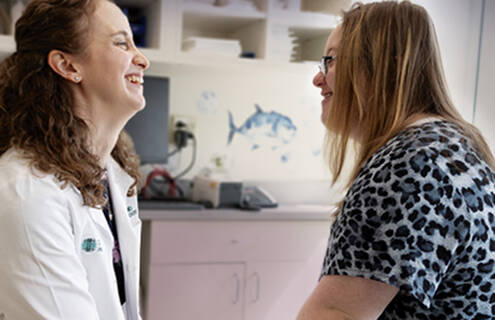
People with Down syndrome are no strangers to specialty care. They regularly see a host of physicians—geneticists, cardiologists, endocrinologists, gastroenterologists, and others—to keep their vital internal organs healthy. But their largest external organ has not historically received the same attention, either in medical practice or in research.
“The skin is often the forgotten organ,” says Jillian Rork, MD, a pediatric dermatologist at Dartmouth Health’s Dartmouth Hitchcock Clinics Manchester and a faculty member at the Geisel School of Medicine at Dartmouth. “There’s a huge spectrum of health conditions in children and adults with Down syndrome, and some are severe, so they need a lot of attention. For that reason, skin conditions might be put on the shelf because they aren’t life-threatening.”
Some of the skin conditions that people with Down syndrome often face can be extremely painful and difficult to treat. There are special considerations physicians must consider when taking care of a patient with Down syndrome: an understanding of coexisting health conditions, particular side effects of medications, and most importantly, how to promote effective, patient-centered communication and self-advocacy.
That’s why Rork established the Down Syndrome Dermatology Clinic in Manchester, New Hampshire. The clinic, which is offered once a month, provides specialized treatment to both children and adults with Down syndrome.
A new dermatology model
Opened in 2021, the clinic is the only one of its kind in the nation. Patients come from all over the country—sometimes even crossing international borders from Canada—for appointments.
“Dr. Rork’s work establishes a compassionate standard of care that serves as a model for other dermatologists around the country,” says M. Shane Chapman, MD, MBA, chair of the Department of Dermatology at Dartmouth Hitchcock Medical Center (DHMC) and Geisel.
Why people with Down syndrome have unique needs
People with Down syndrome, or trisomy 21, have three copies of chromosome 21 instead of the standard two. This difference affects the development of both brain and body, leading to a suite of chronic or recurring health conditions.
People with Down syndrome often have more difficulty fighting infections and a greater occurrence of autoimmune disorders, such as autoimmune thyroid disease and celiac disease, among other health challenges.
They are also at higher risk for hidradenitis suppurativa (HS), alopecia areata, psoriasis, and other skin diseases. “These skin conditions can be really challenging to treat,” Rork says, especially when patients have coexisting medical conditions.
Take HS, for example. “One of the drugs used to treat HS can work really well, but it can lower the patient’s blood pressure, and people with Down syndrome are historically known to have lower blood pressures,” she explains.
Other health risks for people with Down syndrome
“People with Down syndrome are more prone to respiratory conditions, and some of the medications for HS turn down the immune system, making patients potentially more vulnerable to respiratory infections,” Rork says. “These patients are also more prone to specific types of blood cancers, and some HS medications can increase the risk of blood cancers. We need to be constantly asking: ‘What are these risks like for someone with Down syndrome?’”
These co-occurring challenges are also the subject of Rork’s research. In fact, consideration of heart health in these patients is the basis of her new study, “Down Syndrome and Psoriasis: An Investigation of Cardiometabolic Risk.”
Why patients come to her
“Dr. Rork looks at the whole person, not just the skin,” says Susannah Hakeem, whose daughter, Martyria “Marmar” Hakeem, has been a patient at the clinic for more than two years.
“She always considers, ‘What is this medication going to do to Marmar’s kidneys or stomach or liver?’ Rork looks at every piece of the puzzle, not just her piece.”
Rork’s specialty knowledge brings patients from far and wide to visit her clinic. “Even if we were to move out of state, we’re going to go to wherever she is,” says Hakeem, whose family already lives about an hour and a half from the clinic.
A resource for healthcare providers
As one of the few researchers studying the intersection of dermatology and Down syndrome, Rork has become a go-to resource for healthcare providers who have questions about the best ways to treat their patients with Down syndrome.
She often serves as a medical management consultant for dermatologists across the country, advising her colleagues on treating patients with Down syndrome.
Recently, Rork also worked with the Society for Pediatric Dermatology and the patient advocacy and research group LuMind to develop specialized handouts for skin conditions in people with Down syndrome, and she ensured they were vetted by other pediatric dermatologists. The published handouts now serve as educational material for both providers and patients about what to expect with common skin conditions experienced by people with Down syndrome.
Rork is also working to build a network of informed dermatologists and is already helping her patients who live far from New Hampshire locate someone with this expertise closer to home.
“There’s an amazing community of other dermatologists that we’ve identified in every corner of the U.S.,” Rork says.
Modeling specialized care for other clinics
As the first of its kind in the nation, the subspecialty clinic will inspire other healthcare systems to create similar clinics, Rork hopes.
“Over the past few years, we have learned a lot,” says Rork, who is also co-director of the Down syndrome subgroup for the Pediatric Dermatology Research Alliance (PeDRA). “We would love to be a model for other clinics.”
But she emphasizes that “you can’t wing it”—starting this kind of program takes significant preparation.
“I never want to feel rushed in this clinic,” says Rork, who allots an hour for each appointment. “Those are the ‘little extras’ that make all the difference in the world; they make people feel comfortable coming back to see us.”
These “extras” also include social and behavioral considerations, as well as encouraging patients to be self-advocates. “We involve them in the decision-making process,” she adds.
“Sometimes physicians assume that people with Down syndrome won’t want to pursue certain treatments. So, we must ask them and not exclude them from helpful treatments because you think they won’t be able to deal with a needle [for injections], or have a biopsy, or have something frozen off.”
The felt benefits of personalized care
“Marmar gets very nervous when going to doctor appointments, but Dr. Rork explains things to her at her level, not just to me and my husband as the parents,” Hakeem says.
“She talks to Marmar herself and treats her as a person, not as the caseload of the day. She makes everything personal to Marmar. If other doctors would follow in Dr. Rork’s footsteps, that would be a very good thing.”
This article first appeared in Vitals Magazine, a publication of Dartmouth Health and Geisel School of Medicine, and has been edited for the Dartmouth Hitchcock Medical Center and Clinics website.