



The pollen counting station is going to help us zero in on the most problematic allergens in our area. That means we can tailor the tests and treatments we offer, targeting what is most relevant for our patients.
Erin L. Reigh, MD, MSThe oppressive summer heat may be over, but for people impacted by seasonal allergens, the suffering has just begun. The third week of September is known as “peak week” in hospitals nationwide, as emergency departments see their highest numbers of allergy and asthma patients of the year. The confluence of elevated ragweed pollen counts, mold from leaves starting to fall, and increased viral transmission from the start of the schoolyear equates to sneezing and discomfort for many, but can result in emergency breathing concerns for others.
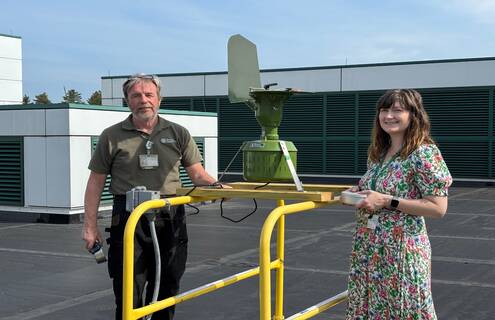
To help researchers studying the impact of environmental allergens on asthma and allergy sufferers, and how a changing climate is affecting pollen and spore counts, Dartmouth Health’s Dartmouth Hitchcock Medical Center (DHMC) partnered with the National Allergy Bureau (NAB) to install a pollen counting station on the roof of DHMC’s power plant. Led by allergy and clinical immunology specialist Erin L. Reigh, MD, MS, samples collected in the pollen counting station will be reported back to NAB for inclusion in its national tracking of environmental allergen levels.
“There are only about 60 active certified pollen counting stations in the United States, which means the pollen counts that patients see on the news are sometimes gathered from stations hundreds of miles away,” Reigh said. “A lot of pollen counting stations are also located in big cities, which is obviously a very different environment as well. I really wanted more accurate information for our patients.”
Pollen and mold particles are filtered through the station and collected on a metal drum coated in a sticky film. Reigh removes the samples from the drum and observes and identifies them with a microscope. DHMC’s station is the only one currently operating in New England, with the next closest located in Rochester, NY. Supplying this data to NAB provides valuable information to researchers regarding which environmental allergens are flaring up in certain areas, and if warming temperatures over time are contributing to longer, more intense allergy seasons.
“Pollen seasons are changing,” Reigh said. “Studies show that ragweed season is two to four weeks longer than it was in the 1990s, and we are seeing allergenic plants spread farther north with the warmer temperatures. Higher CO2 levels also cause ragweed plants to release more pollen.”
Reigh became certified in pollen identification through NAB after observing the struggles many of her patients go through during allergy season. Some people require custom-mixed allergy shots based on what allergens are making them sick, she said, so having a better understanding of what allergens are present in the area gives her a better idea of what her patients need.
“Allergy shots are a way to retrain the immune system to stop reacting to an allergen,” Reigh said. “You have to have a good understanding of the local allergens to know what to include in the allergy shots, or they won’t be effective. The pollen counting station is going to help us zero in on the most problematic allergens in our area. That means we can tailor the tests and treatments we offer, targeting what is most relevant for our patients.”
To subscribe to allergen reports from DHMC’s pollen counting station, visit pollen.aaaai.org.
About Dartmouth Health
Dartmouth Health, New Hampshire’s only academic health system and largest private employer, serves patients across New England. Dartmouth Health provides access to more than 2,300 providers in nearly every area of medicine, delivering care at its flagship hospital, Dartmouth Hitchcock Medical Center (DHMC) in Lebanon, NH. Its network of hospitals, outpatient centers, clinics and home care facilities, spans a broad geographical area. Year after year, DHMC is named the #1 hospital in New Hampshire by U.S. News & World Report, and is consistently recognized for high performance in numerous clinical specialties and procedures. Dartmouth Health includes Dartmouth Cancer Center, northern New England’s only National Cancer Institute-designated Comprehensive Cancer Centers and one of less than than 60 total nationally; Dartmouth Health Children’s, which includes the state’s only children’s hospital, the Golisano Children's Hospital at Dartmouth Health, and more than 20 locations around the region; eight member hospitals in Lebanon, Keene, Claremont, Hampstead, and New London, NH, and Windsor and Bennington, VT; Dartmouth Health Home Care; Dartmouth Health Connected Care Center for Telehealth, serving patients as far away as Texas; and more than 30 primary and multi-specialty clinics across New Hampshire and Vermont. Through its partnership with Dartmouth College, Dartmouth’s Geisel School of Medicine and the White River Junction VA Medical Center, Dartmouth Health trains nearly 400 medical residents and fellows annually and performs cutting-edge research and clinical trials with international impact. Dartmouth Health and its more than 16,000 employees are committed to serving the healthcare needs of everyone in the communities it serves and to providing every patient with exceptional, state-of-the-art, personalized care. Learn more at dartmouth-health.org.