



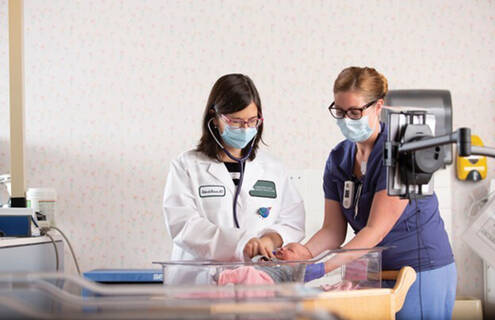
In rural America, specialist newborn care can sometimes be difficult to get.
But a new telemedicine technology called TeleICN now puts expert neonatal support within reach for new mothers, their babies, and their care team at the bedside.
In real time and via video, board-certified neonatologists can help provide the critical care needed for newborn babies, especially those born prematurely, with serious illness, or who are at high-risk.
This expertise can make a crucial difference at a time when specialized maternity services can be hard to access, particularly in rural America.
“Babies aren’t simply small adults, and they’re different from older children too,” says Michelle D. Tyler, MD, MPH, a neonatologist with Dartmouth Health’s TeleICN program. “They can’t speak for themselves, and the situations they face, especially when they’re born very early, are uncommon. Their needs are unique, and they require care tailored specifically to them.”
Needed support when maternity services in rural America are vanishing
According to a report from the Center for Healthcare Quality and Payment Reform, fewer than half of rural hospitals (42%) still deliver babies.
Since 2020, more than 100 facilities have shut down their labor and delivery units.
For many families, the nearest hospital offering maternity care is now more than 30 minutes away, and in some places, nearly an hour or longer. When complications arise, that added distance can make an already stressful situation even more challenging when a newborn needs urgent care.
How TeleICN works
Supported by Connected Care and Center for TeleHealth, TeleICN gives clinicians at rural and community hospitals immediate access to a Dartmouth Health neonatologist 24 hours a day, seven days a week. The connection uses a secure mobile device, allowing the neonatologist to see the newborn, evaluate the situation, and guide the local team.
At its core, TeleICN is designed to support the skilled clinicians, building on their expertise and strengthening local care rather than replacing it. The goal is collaboration and shared decision-making when situations are rare, complex, or time-sensitive.
Why it matters
TeleICN’s collaborative approach is a central part of how TeleICN supports bedside teams, says Jessica G. Clem, MD, MPH, a neonatologist and medical director of TeleICN at Dartmouth Health.
“TeleICN gives teams another set of eyes at the bedside,” Clem says. “These situations don’t happen every day, and when they do, having another expert perspective helps teams talk through decisions in real time.”
While most community hospitals deliver healthy newborns every day, extremely premature or critically ill cases are rare and require a skill set local providers don’t use every day. TeleICN provides an added layer of support in those moments, bringing neonatal expertise directly to the bedside when it matters most.
Depending on the situation, TeleICN support may include:
- Guidance during neonatal resuscitation
- Evaluation and treatment guidance for respiratory distress
- Consultation during high-risk situations or unexpected deliveries
- Support in determining whether transfer to a higher level of care is necessary
TeleICN is designed for speed and simplicity: bedside teams connect with a neonatologist with no telehealth carts or complex equipment required.
“It’s about helping teams talk through goals of care and support families in real time, so everyone is focused on what’s best for the baby, at the moment it matters most,” says Clem.
That shared approach helps ensure families receive clear, compassionate communication while remaining connected to the clinicians they already know and trust.
Signs of success
TeleICN is strengthening care delivery for newborns and supporting rural hospitals across the region, and its impact is reflected in how clinicians are using the service.
Clinicians are engaging TeleICN earlier and more often. From 2024 to 2025, usage increased by 48%, reflecting growing confidence and a shift toward engaging neonatal expertise earlier in an emergency.
The earlier engagement is making a difference at the bedside. In more than one-third of TeleICN consultations, newborns were able to stay local at their birth hospital if they are a labor and delivery site. For families, this can mean staying together and avoiding the cost and disruption of hours-long travel during an already stressful time.
For clinicians, the impact is immediate and tangible. As one rural clinician shared in a post-call survey: “The provider was quick to respond and saved this patient many hours of traveling time.”
Post-call survey results confirm the experience:
- 100% agreed that using TeleICN improved the baby’s care
- 100% agreed the technology was easy to use
- 95% agreed they were connected to the neonatologist promptly
The result is TeleICN is changing how clinicians approach complex situations, increasing clinician confidence, supporting timely decision-making, and helping ensure newborns receive specialty-level care when and where it is needed, even when a neonatologist is miles away.
“What we’re seeing is a shift in how rural clinicians use neonatal expertise,” says Clemens. “They’re reaching out earlier, talking through decisions in real time, and gaining confidence with each case. That kind of support can change how a situation unfolds at the bedside.”