



If you are interested in becoming a living kidney donor, please submit our Living Kidney Donor Questionnaire, or call our clinic to speak with the living kidney donor coordinator.

How One Woman’s Selfless Act to Donate A Kidney Led Her to the Top of the World
Less than a year after donating a kidney, Maureen Murphy hiked Mt. Kilimanjaro in Tanzania, Africa, to raise awareness for organ donation.
Who can be a donor?
To be considered, you must:
- Be at least 21 years old
- Be in excellent physical and mental health
- Not be pregnant or have given birth within the past year
- Have a primary care provider (PCP) and be up to date with an annual physical and age-appropriate routine cancer screenings. We would be happy to help you find a primary care doctor if needed.
We strongly recommend that you have health insurance. Even though you and your insurance will not pay for donation-related medical costs, you may still have costs if testing finds a new health problem you did not know about.
Steps to become a living kidney donor
Step 1: Learn About Donation
Before getting started, review these helpful resources about living kidney donation, available financial support, and transplant outcomes. These tools will help you understand the process and make an informed decision about moving forward.
- Living Kidney Donation: Giving the Gift of Life (DH)
- UNOS Living Donation Booklet
- National Living Donor Assistance Center
- Scientific Registry for Transplant Recipients (SRTR) Program Data and Outcomes
Step 2: Contact us
To express your interest in becoming a living kidney donor, submit our Living Kidney Donor Questionnaire, or contact us.
Intake call and consent form
- We will schedule you for an intake call with our living kidney donor coordinator. During this call, we will review your health history and discuss the living donation process.
- Before we can begin testing, you must sign and return the Living Donor Evaluation consent form. This form is sent electronically by DocuSign after your intake call, if you are eligible. If you prefer to physically sign the consent, you may print and mail it to us:
- Consent to be Evaluated as a Living Donor (PDF)
Dartmouth Hitchcock Medical Center
1 Medical Center Drive
2M Solid Organ Transplant
Lebanon, NH 03756
Attn: Living Donor Coordinator
- Consent to be Evaluated as a Living Donor (PDF)
Step 3: Complete initial testing
We will complete tissue typing and cross-matching to ensure you and the kidney recipient are compatible. This test requires a blood draw. Test results normally take 7 to 10 days to process.
Compatibility
If you and your recipient are not compatible, you can exchange kidneys with another pair of patients who are also incompatible. In this scenario, both recipients receive a living donor kidney transplant.
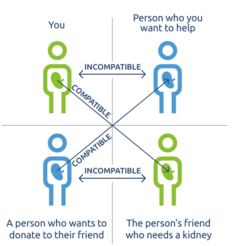
For more information about kidney paired donation, visit our partnering organizations’ websites:
You will also complete a 24-hour urine collection and fasting bloodwork. We perform these tests to assess kidney function and identify risk factors for developing kidney disease.
Step 4: In-person evaluation
If your labs look good, the Transplant Surgery Team will schedule you for an evaluation. The evaluation includes an examination by a nephrologist (kidney doctor) and a transplant surgeon. During the appointment, the nephrologist will review your medical history and current physical condition. You will also meet with our:
- Living donor coordinator
- Dietician
- Financial coordinator
- Pharmacist
- Social worker
- Independent living donor advocate (ILDA)
The nephrologist will order additional tests, including blood and urine tests, a chest X-ray, an electrocardiogram (EKG), an exercise stress test with an echocardiogram (if over the age of 50), and a CT scan with intravenous (IV) contrast, to ensure you have two healthy kidneys.
Our goal is to make sure kidney donation is safe for you and to provide you with information so you can make a fully informed decision.
5 Common Misconceptions About Donating Your Kidney While You're Healthy and Alive
Michael Daily, MD, Section Chief of Solid Organ Transplantation at Dartmouth Hitchcock Medical Center, shares how living donors can lead healthy, long lives and save others with a kidney donation..
Step 5: Multidisciplinary Committee Review
After your evaluation, the transplant team will review your case. The living donor coordinator will call you to discuss the team’s decision. If you are approved, we will schedule your surgery.
Step 6: Prepare for Surgery
About 2 weeks before the scheduled surgery date, you will undergo a final cross-matching test with the recipient. This is to make sure you and the recipient are still compatible. You will also meet with your surgeon and have pre-admission testing.
Medications
Avoid aspirin and non-steroidal anti-inflammatory drugs (NSAIDs), such as Advil or Aleve, for at least 7 days before surgery. These medications increase the risk of bleeding during surgery.
Women who take birth control pills must stop taking them 30 days before surgery. They must also wait at least 3 months after surgery before resuming use. Birth control pills increase the risk of blood clots.
Smoking
Smokers are at higher risk for pneumonia (lung infection), incisional hernia and poor wound healing. We encourage you to quit, and with your consent, we will help you do so. If you decide to quit, you must do so at least 4 weeks before surgery.
Step 7: Surgery
The day before surgery: You should eat a light, early dinner. Do not eat after midnight.
The day of surgery:
On the day of your surgery, you will:
- Follow instructions from our team about your prescription medications.
- Be admitted to the same-day surgery center.
- Have an IV placed and blood drawn, after which you will go to the operating room.
At Dartmouth Hitchcock Medical Center, all live donor kidneys are removed using a minimally invasive technique. This technique reduces the pain and discomfort for the donor and allows a faster recovery. The surgery takes about 3 to 4 hours to complete.
After surgery: Living kidney donors are usually ready to go home 1 or 2 days after surgery.
Step 8: Follow-up Visits and Return to Normal Activity
You will need to return for a follow-up visit 2 weeks after leaving the hospital. You must avoid driving until this visit, or until cleared by the surgeon. Living kidney donors usually return to work 4 to 6 weeks after laparoscopic surgery. You also cannot lift more than 10 pounds for 6 to 8 weeks after donation to reduce the chance of incisional hernia.
The living donor team will see you—or at least check in and review lab results 6 months, 1 year, and 2 years after your donation. The vast majority of patients who donate will quickly recover to normal or near-normal kidney function.
Yearly check-ups with your primary care provider are essential for monitoring and preventing conditions that can affect kidney health and are strongly recommended after kidney donation.